
Start with the room, not the rack
Before anyone talks about desks or microphone models, we walk the room. A studio floor tells you a great deal in ten minutes: where the air conditioning hums, which wall throws a hard reflection back at the presenter, and how far the guest chairs sit from the nearest cable run. Our notes from that walk shape every later decision.
We carry a small kit for this. A handheld reference microphone, a pair of closed headphones, a tape measure and a notebook. Nothing clever, but it means we arrive at the planning meeting with observations rather than assumptions, and the producer can see why a particular chair has moved.
On mid autumn shoots the walk matters more than usual. Heating comes on, doors are propped open for loading, and background noise changes from one week to the next. We check again on the day.
- Clap test for flutter echo
- Listen at presenter and guest positions
- Note every hum source
- Mark cable routes on the floor plan
Microphones we choose for speech
For news desks and talk sets we favour small lavalier microphones as the main pick-up, with a boom or a hidden desk microphone as a back-up. Lavaliers sit close to the voice, so they reject most of the room, and they stay put when a presenter turns to a second camera.
Placement is where the craft sits. We clip at the breastbone, about a hand's width below the chin, and route the cable under clothing with a small loop of slack so movement does not tug it. Fabric rustle is the most common fault we fix, and it is almost always a clip placed against a jacket seam.
We keep two spare capsules per presenter and a pack of foam covers. A failed microphone minutes before a bulletin should be a thirty-second swap, never a debate.
Music-led shows ask different questions
Live music changes the order of work. With a band, the first question is separation: how much of the drum kit leaks into the vocal microphone, and can we move things a metre before reaching for any processing? Physical changes cost nothing and sound better than any fix in the desk.
We use a modest set of dynamic microphones for loud sources and a pair of small condensers overhead for the kit. We label every channel on tape and on the desk, because the engineer who reads the desk at midnight may not be the one who patched it at noon.
Line checks go instrument by instrument, with the musician playing at performance level. A quiet check always lies, and the first chorus then reveals what the soundcheck hid.
- Patch list agreed with the band in advance
- Gain set at performance volume
- Spare leads and batteries at the desk
Desk setup that a stand-in can read
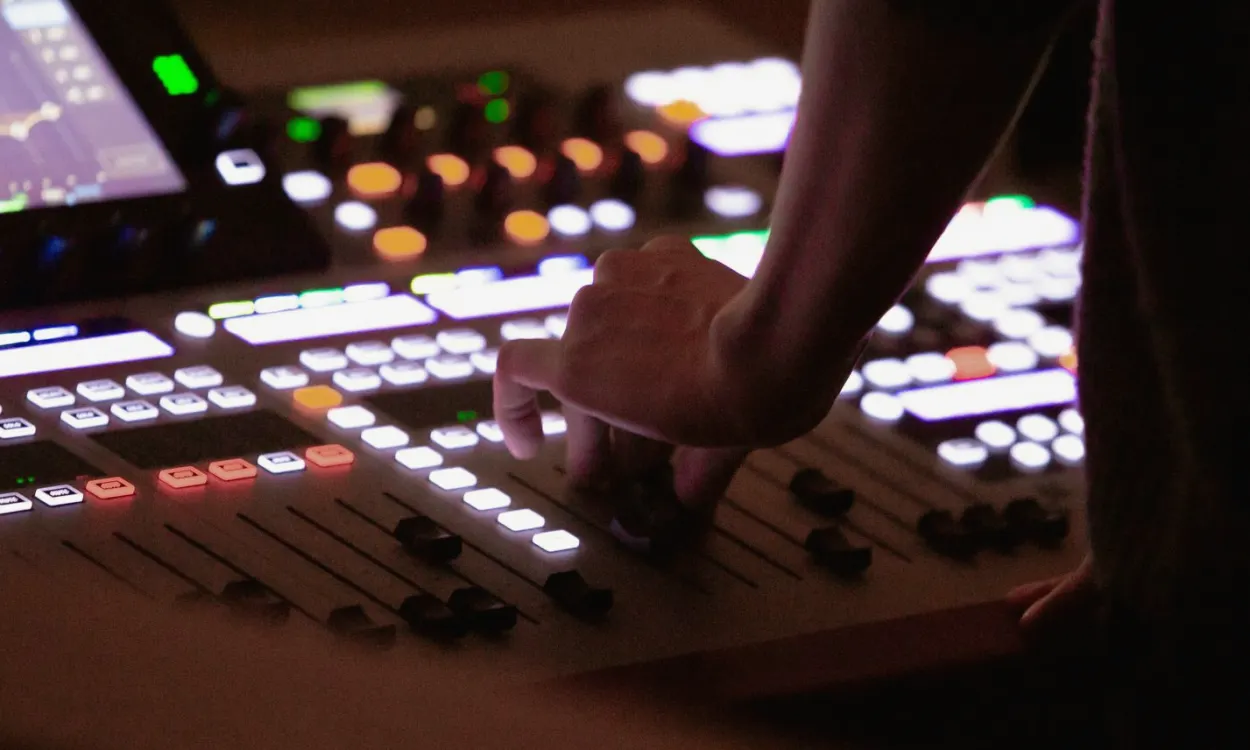
Our mixing desk routine is built around one idea: someone else may have to take over. Channels run in a fixed order, presenters first, guests next, playback and music after that, with groups and a clear master section on the right. Colours follow the same pattern from show to show.
We save a scene for every production and name it plainly, with the format and the location in the title. If a producer asks for last Tuesday's talk set, it loads in seconds, and the differences are small enough to correct by ear.
Gain structure gets the most attention. Healthy levels at the input, moderate faders and headroom at the master mean the desk is never fighting itself, and a loud laugh from the floor does not turn into distortion.
Monitoring: what we listen on and why
We mix on closed-back headphones and check on a pair of small studio monitors, because viewers hear the result through television speakers, laptops and phones. A mix that only works on expensive speakers is not finished.
Talkback matters as much as programme sound. Presenters need a clean return of their own voice and the producer's cues, at a level that does not leak into their microphones. We set earpieces individually and ask each person to confirm before we go to rehearsal.
Midway through a show we step away from the desk for a minute and listen to the gallery feed on a small speaker. It is a habit that has caught more problems than any meter.
- Closed headphones for detail
- Small monitors for balance
- Individual talkback levels per person
Keeping the kit list short
We resist adding gear for its own sake. Every item we bring has a clear job, a known failure mode and a spare. A short list is quicker to pack, easier to check against a manifest, and far simpler to explain to a floor manager at seven in the morning.
After each production we log what went wrong, however small: a crackling connector, a belt pack that needed fresh batteries too early. Faulty items leave the rotation, and notes feed the next planning sheet.
None of this is glamorous, but it is why a sound department can be quiet during a live show. Most of the work is finished before the first rehearsal, and that is how we like it.
Good sound management is mostly preparation: a walk of the room, a short and tested kit list, a desk another engineer can read, and monitoring that reflects how the audience actually listens. If you are planning a speech-led or music-led production this winter, we are happy to talk through your room and your format before anyone unpacks a case.